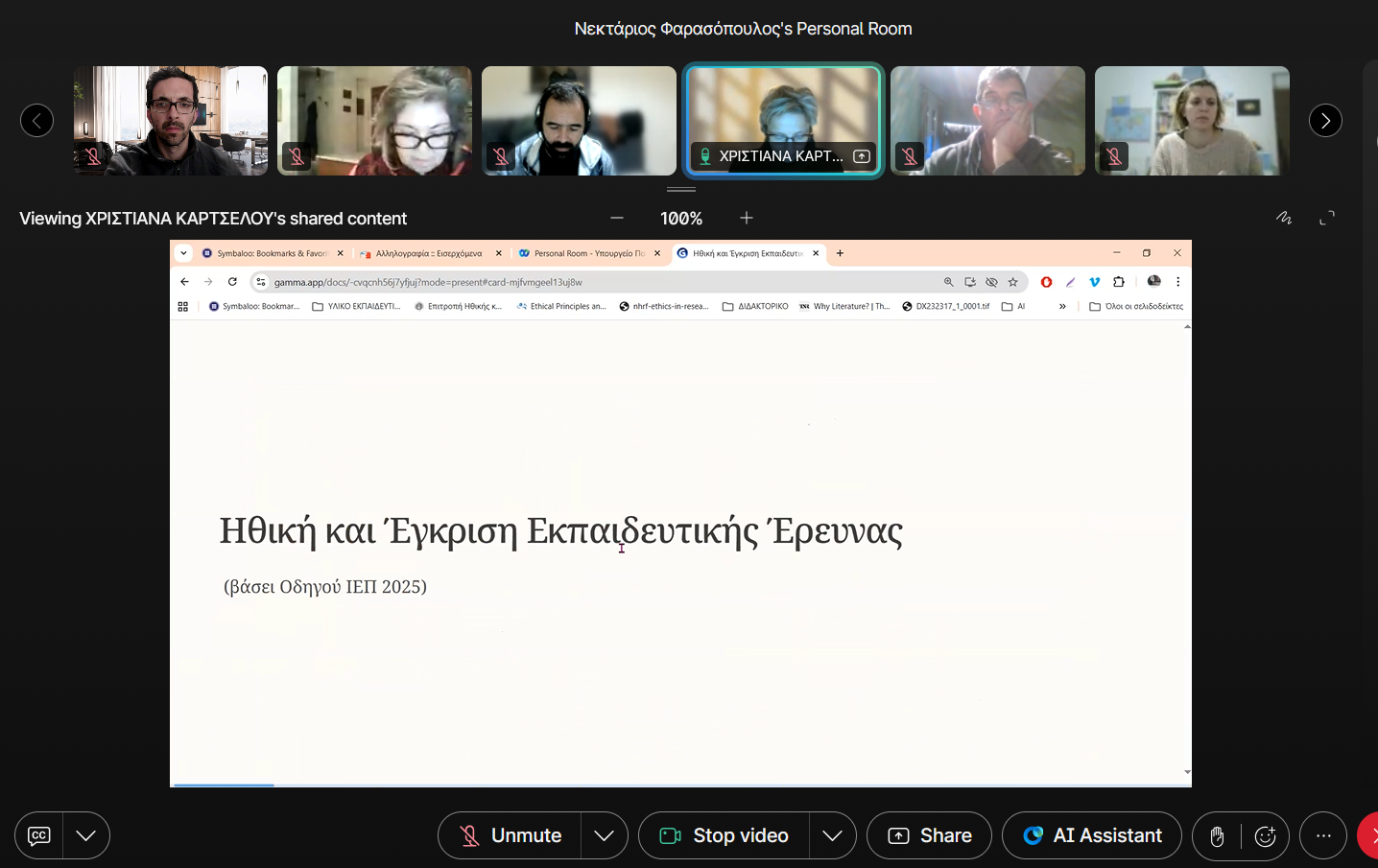
As part of the ongoing implementation of the EMPATHER project, the Privacy Review Board (PRB) recently welcomed Ms. Christiana Kartselou, School Counselor at the Directorate of Primary Education of Cyclades (DIPE CYCLADON), for a dedicated online session focusing on the ethical and regulatory dimensions of educational research.
The session took place during one of the monthly meetings of the EMPATHER Privacy Review Board and provided members with a valuable opportunity to deepen their understanding of the national and European frameworks that guide ethical research practices in educational settings.
Drawing on her extensive experience in education and school support, Ms. Kartselou presented the key principles governing educational research in Greece, highlighting the procedures, safeguards, and responsibilities that researchers must consider when conducting studies involving students, teachers, schools, and educational communities. Particular attention was given to the protection of minors, informed consent processes, data protection requirements, and the importance of maintaining trust and transparency throughout the research process.
The discussion also explored the broader European context, including the growing emphasis on responsible digitalisation, ethical use of data, privacy-by-design approaches, and Open and Responsible Research and Innovation (ORRI). Participants reflected on how these principles can be translated into practical procedures that support both research quality and the rights of research participants.
The session formed an important contribution to the ongoing development of the EMPATHER ORRI Toolkit, which aims to provide practical guidance, tools, and procedures for embedding privacy, transparency, accountability, and stakeholder participation into educational research activities. Insights shared during the meeting will help ensure that the toolkit remains aligned with current ethical expectations and regulatory requirements while responding to the realities of educational practice.
The EMPATHER Privacy Review Board brings together representatives from the educational community, including educators, parents, students, researchers, and experts, creating a collaborative space for dialogue and reflection on responsible research practices. Through these regular exchanges, the project continues to strengthen its commitment to developing practical and sustainable approaches to responsible digitalisation in educational research.
EDVOCACY would like to thank Ms. Christiana Kartselou for her valuable contribution and for sharing her expertise with the Privacy Review Board. Her insights have enriched the co-creation process and reinforced the project’s mission of promoting ethical, transparent, and trustworthy educational research.